In 2013, one of my clients—an MBA grad from Cornell’s Johnson School—handed me a worn copy of Winning Decisions by J. Edward Russo and Paul Schoemaker. “This is how we learned to think at b-school,” he said proudly. “Focus on the process, not the outcome—get the frame right, gather unbiased intel, decide logically, learn from feedback.” Russo, a Cornell professor himself, had distilled decades of research into a practical toolkit for better judgment in the face of uncertainty. It was smart, structured, and mostly rational. Emotions? They were considered potential sources of bias to manage, not allies to consult.
At the time, I smiled and thanked my client, but I was skeptical. In my work with other clients, I’d seen firsthand what happens when people make decisions from reason alone—shutting out the emotional data that signals values, risks, or deeper needs. Outcomes might look clean on paper, but lives (and businesses) rarely are.
Essentially, the book argues that the quality of a decision should be judged by the soundness of the method rather than the outcome alone. In other words, good decisions are not necessarily outcome-determinative. At the time, this struck me as counterintuitive. The four-step decision-making process it recommends is largely rational: framing the decision intelligently, gathering intelligence without bias, forming conclusions thoughtfully, and learning from experience.
Wise Mind in DBT: Integrating Emotion and Reason
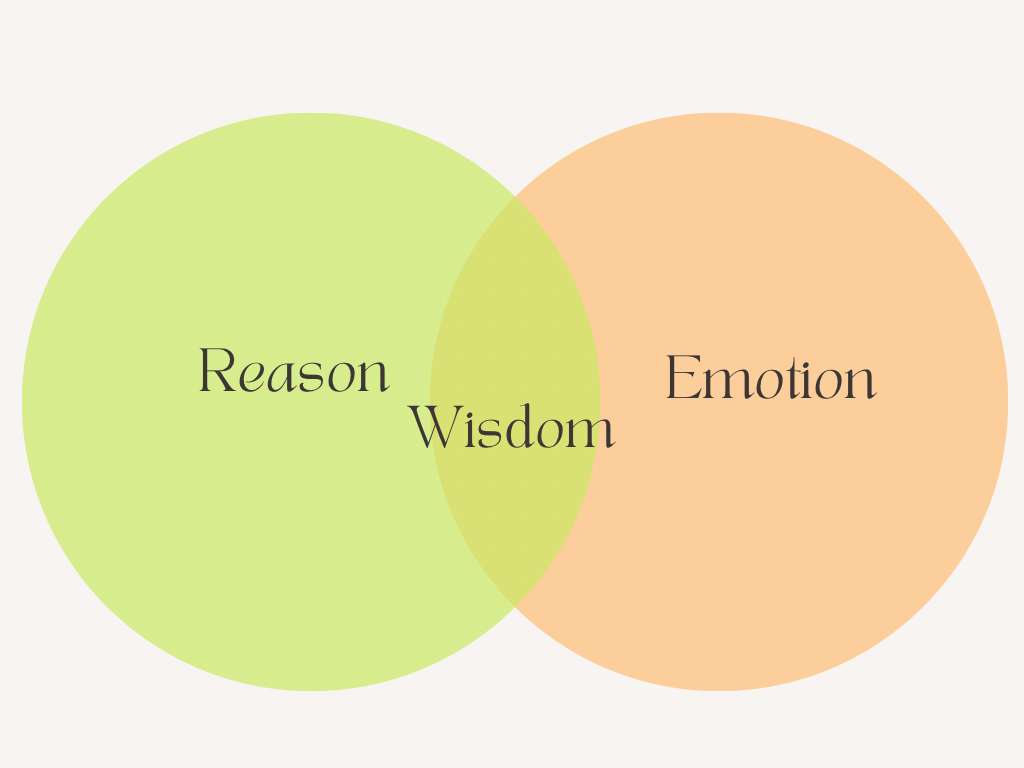
In dialectical behavior therapy (DBT), a Zen-based treatment, emotions are viewed as part of our inherent wisdom. When individuals make decisions from their “Wise Mind,” both emotions and reason are taken into consideration. Wise Mind is the dialectical synthesis of reason and emotion, plus intuitive knowing. Decisions made in Wise Mind align with the individual’s values and long-term interests.
HBR’s Quiet Evolution on Emotions in Decision Making
Over the years, I’ve enjoyed watching Harvard Business Review’s pages quietly shift in a direction that validates what DBT has long taught: emotions have an important role in decision making.
2006: Emotions as Potential Hijackers
In the January 2006 issue, Gardiner Morse’s article “Decisions and Desire” offered a neuroscience-backed perspective. Morse explained how the “primitive” emotional brain can aggressively influence and even hijack decisions, leading to impulsivity or paralysis. Consistent with the rational model’s wariness, emotions were framed as powerful but potentially disruptive forces.
2007: The First Pushback – Emotions Can Fuel Good Decisions
By December 2007, we begin to see some pushback against the idea that emotions are the enemy. Andrew O’Connell’s short HBR piece “How Emotions Fuel Good Decisions” cites emerging research suggesting that strong emotions—far from clouding judgment—can actually improve decision quality by sharpening focus and motivation.
2015: A Nuanced Middle Ground
A more nuanced view emerged in the 2010s with articles such as Francesca Gino’s “Don’t Let Emotions Screw Up Your Decisions” (2015). She points out that emotions can direct attention to what is most important in complex choices, but high emotional intensity can derail the process.
The 2020s Embrace: Emotions as Leadership Assets
The 2020s have brought a fuller embrace of emotions in decision making, with pieces such as “Emotions Aren’t the Enemy of Good Decision-Making” (2022) and “The Best Leaders Normalize Emotion at Work” (2025). Consistent with DBT, emotions are now discussed as signals of values, risks, and priorities. The authors caution that rushing past emotional discomfort can actually lead to worse outcomes. Instead, sitting with emotions thoughtfully yields better, more aligned decisions.
Fast forward to Dina Denham Smith’s 2025 piece, “The Best Leaders Normalize Emotion at Work.” Here, the old fear that emotions cloud judgment or hinder decisions is directly confronted. Smith argues that the best leaders notice, name, and get curious about emotions—treating them as data that sharpens clarity and resilience rather than derailing logic.
From Rational Tools to Wise Integration
As I’ve watched HBR evolve—from the 2006 warning that our “primitive” emotional brains could hijack us, to the recognition that emotions are not the enemy, and finally to a call for leaders to normalize them as assets—I can’t help but feel vindicated.
The very business world that once handed me Winning Decisions with its structured, largely rational process has slowly arrived at the same truth I teach my DBT clients: emotions are not contaminants to filter out. They are data, signals, and sometimes the wisest voice in the conference room.
In the end, the most effective decision-makers—whether in the boardroom or in life—don’t choose between reason and feeling. They access inherent wisdom, or Wise Mind: the synthesis of reason, emotion, logic, and intuition.
After all these years, it turns out the ancient Buddhist insight that emotions carry potential wisdom wasn’t “soft.” It was just ahead of its time. And if HBR is any indication, the rest of the corporate world is finally catching up. Better late than never.
See more on: Dr Lisa’s Instagram